
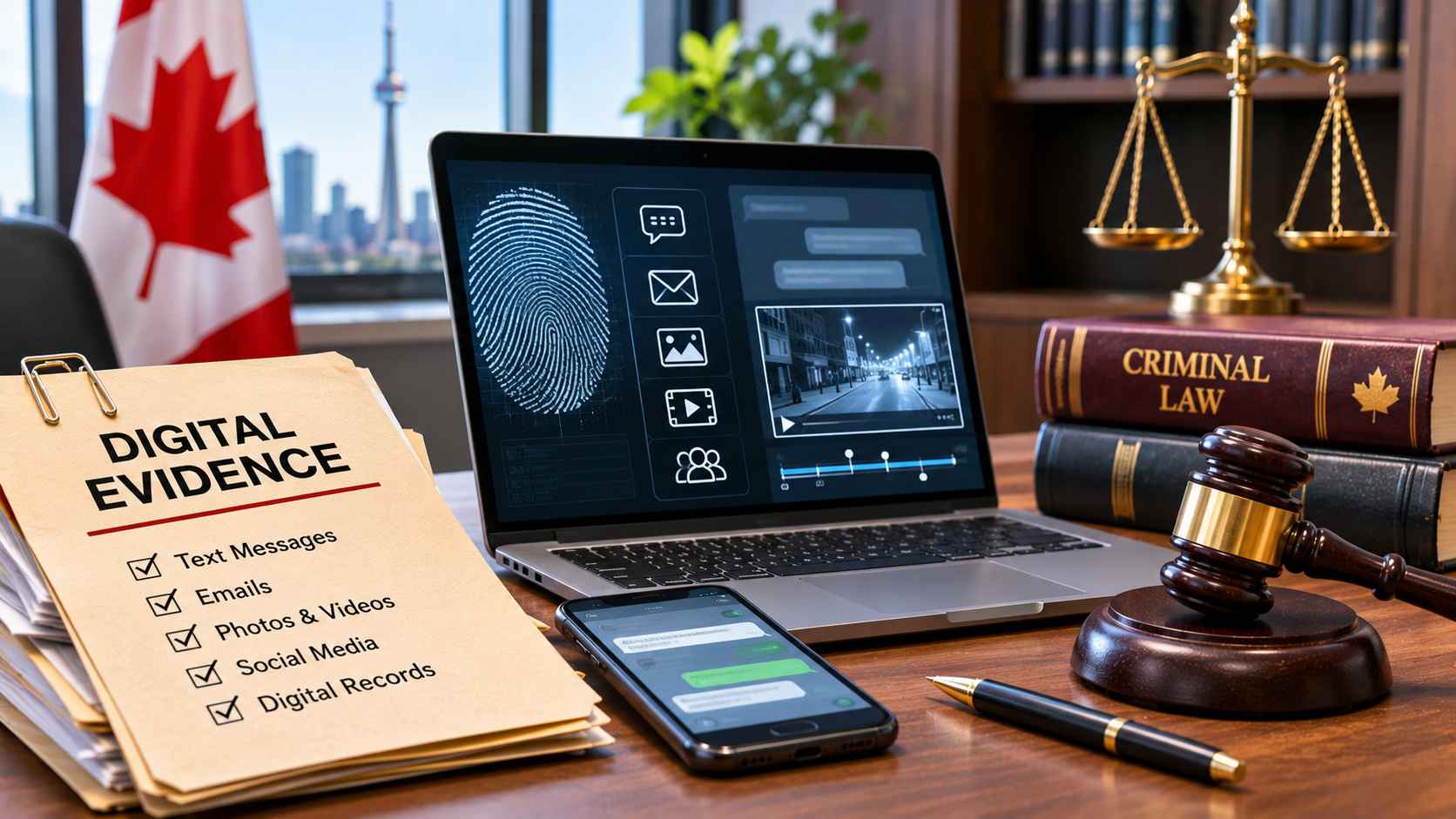
Digital technology has become an important part of everyday life. People regularly communicate through text messages, emails, social media platforms, and messaging applications. These interactions create digital records that may become relevant when police investigate suspected criminal activity.
In Canada, digital evidence can help investigators understand communications, establish timelines, and examine circumstances surrounding an alleged offence. However, electronic information must be collected and evaluated carefully because digital records do not always provide a complete picture of what happened.
Understanding how digital evidence may be used in criminal investigations can help individuals appreciate the importance of privacy, accurate information, and fair legal procedures.
Understanding Digital Evidence in Criminal Investigations
Digital evidence refers to electronic information that may be relevant to a criminal investigation or court proceeding.
It can include text conversations, emails, photographs, videos, social media posts, location-related records, and information stored on computers or mobile devices.
Unlike traditional physical evidence, digital information may exist across multiple devices, accounts, or online services.
For individuals facing criminal allegations in Ontario, understanding how this information may affect a case is important. Criminal defence professionals such as Stephen Jack Criminal Lawyer help accused individuals navigate criminal proceedings and examine evidence relevant to the allegations they face.
However, digital evidence must still satisfy applicable legal requirements before it can be relied upon in court.
How Text Messages and Emails May Become Evidence
Text messages and emails are common forms of digital communication that may become relevant during criminal investigations.
Investigators may examine these communications to understand relationships, identify conversations about particular events, or determine what individuals said at specific times.
For example, electronic messages may contain information about meetings, disagreements, transactions, or other circumstances connected to an investigation.
However, a single message does not necessarily explain the complete situation.
A short response may have a different meaning when considered alongside earlier messages or the relationship between the participants.
Investigators and legal professionals may therefore need to examine the broader conversation rather than relying on isolated statements.
The authenticity of electronic communications may also need to be established. This can involve considering whether the records accurately represent the original exchange and whether the identities of the participants can be verified.
The Role of Photographs, Videos, and Social Media Content
Photographs and videos may provide valuable information during criminal investigations.
Images can help document locations, objects, injuries, property conditions, or events that may be relevant to an allegation.
Similarly, video recordings from security cameras, mobile devices, or other sources may show particular activities.
Social media content can also become part of an investigation.
Public posts, comments, photographs, and online interactions may contain information connected to an alleged incident.
However, digital images and social media records should not automatically be treated as complete or conclusive evidence.
Photographs may lack surrounding context, while videos may capture only a limited portion of an event.
Social media posts can also be misunderstood when viewed separately from earlier communications or other relevant circumstances.
For these reasons, courts may need to consider authenticity, reliability, and the context in which digital content was created.
How Digital Records Can Help Establish Timelines
Establishing when events occurred can be important in a criminal investigation.
Digital records may contain dates, timestamps, or other information that helps investigators develop a sequence of events.
Examples include:
- Messages and emails: Records may show when communications were sent or received.
- Photographs and videos: Available metadata may contain information about when a file was created.
- Electronic transactions: Records may help establish when particular activities occurred.
- Location-related information: Certain devices or services may retain location information, depending on their settings and available records.
- Online account activity: Login records or other account information may sometimes assist in establishing timelines.
Although these records can be useful, their accuracy should not be assumed without examination.
Device settings, time zones, system differences, and incomplete records may affect how timestamps are interpreted.
Digital timelines are therefore most useful when examined alongside other relevant evidence.
Why Context Matters When Reviewing Online Communications
One of the greatest challenges with digital evidence is understanding what electronic communications actually mean.
Written messages often lack the facial expressions, tone of voice, and other details present in face-to-face conversations.
Sarcasm, humour, frustration, or informal language may be difficult to interpret accurately.
Additionally, screenshots may display only selected portions of conversations.
This does not automatically make the information unreliable, but it highlights why context matters.
Investigators and courts may consider surrounding messages, the relationship between participants, and other evidence that helps explain the communication.
Careful interpretation is essential because criminal decisions should not rely on unsupported assumptions about someone’s intentions.
The Importance of Preserving Relevant Digital Information
Preserving potentially relevant electronic information is an important responsibility when criminal proceedings are anticipated or underway.
Digital records may become unavailable through routine system changes, device replacement, application settings, or other circumstances.
Maintaining original information can help preserve its accuracy and allow it to be reviewed appropriately.
Individuals should avoid intentionally deleting, altering, fabricating, or manipulating potential evidence.
Such conduct may create additional legal concerns and undermine the reliability of information.
Preservation should also respect privacy rights and lawful access requirements.
People should not attempt to access another person’s private accounts or devices without proper authorization.
When uncertainty exists about handling relevant digital records, obtaining legal guidance can help individuals understand their responsibilities.
Privacy Rights and Lawful Collection of Digital Evidence
Digital evidence raises important privacy questions because mobile phones and online accounts can contain extensive personal information.
In Canada, Section 8 of the Canadian Charter of Rights and Freedoms protects individuals against unreasonable search or seizure.
The Criminal Code of Canada also establishes legal procedures and investigative powers that may apply to obtaining electronic information, including search warrants and production orders.
Depending on the circumstances, police may need appropriate legal authorization before examining private digital information.
However, the requirements vary according to the type of information, how it is obtained, and the applicable law.
Privacy protections do not mean that digital information can never be used in criminal proceedings.
Rather, they help establish boundaries for lawful investigative activities while balancing privacy interests and the administration of justice.
Why Digital Evidence Requires Careful Examination
Electronic records can appear precise, but that does not mean every digital record is automatically accurate or reliable.
Questions may arise about who created a file, whether information has been modified, or whether a record accurately reflects the original material.
Technical examination may help address some of these questions.
Courts may also consider how evidence was collected, stored, transferred, and presented.
Maintaining a reliable record of how evidence was handled can help support its integrity.
Importantly, the relevance of digital material is separate from whether it is legally admissible.
Even information that appears significant must be assessed under applicable evidence rules before it can be used to establish disputed facts in court.
The Role of Legal Counsel in Reviewing Digital Evidence
Criminal defence lawyers play an important role in examining evidence and protecting the procedural rights of accused individuals.
Their work may include reviewing disclosure materials, assessing electronic communications, identifying inconsistencies, and considering whether evidence was obtained lawfully.
In cases involving complex digital records, legal counsel may also consider whether specialized technical examination is necessary.
Individuals seeking criminal defence legal guidance may benefit from understanding how electronic evidence is assessed within the broader context of criminal proceedings.
A lawyer may challenge the admissibility or reliability of particular records where appropriate and ensure that relevant legal issues receive consideration.
Legal representation does not guarantee a particular outcome, but it helps individuals make informed decisions about the evidence and procedures affecting their cases.
Conclusion: Digital Evidence and the Importance of Fair Legal Procedures
Digital evidence has become an important part of modern criminal investigations in Canada.
Text messages, emails, photographs, videos, and online records may help explain events, establish timelines, and provide information relevant to criminal allegations.
However, electronic information must be examined carefully. Context, authenticity, privacy protections, and lawful collection procedures all influence how digital evidence may be used.
Preserving relevant information responsibly and understanding the role of legal counsel can help support fair proceedings.
Ultimately, digital evidence should be evaluated according to established legal standards rather than assumptions, ensuring that technology contributes to accurate and responsible decision-making within Canada’s criminal justice system.


